


The Blue Energy Advantage: How Floating Solar PV Is Redefining Cost Efficiency and Growth
- Apr 29
- 5 min read
The world is changing how it thinks about energy. As countries race to cut carbon emissions and reduce dependence on fossil fuels, solar power has become one of the fastest-growing energy sources on the planet. But land is expensive, scarce, and often better used for farming or housing.
That is where floating solar comes in.
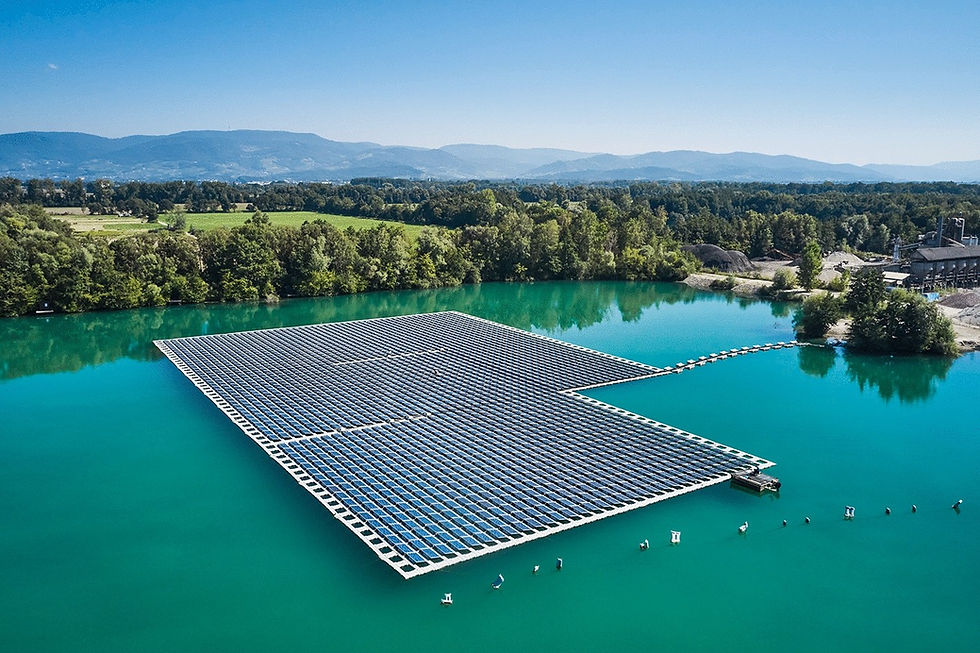
Floating solar PV systems are exactly what they sound like: solar panels installed on water bodies such as lakes, reservoirs, and ponds. This simple but powerful idea is quietly transforming the renewable energy landscape, offering a smarter way to generate clean power without using up valuable land.
What Is Floating Solar and Why Does It Matter
Floating solar, sometimes called floatovoltaics, involves mounting solar panels on buoyant structures that sit on the surface of water. These installations are typically anchored to the bed of the water body and connected to the grid through underwater or overhead cables.
The idea may sound new, but it has been growing steadily since the early 2010s. Today, floating solar projects exist across Asia, Europe, North America, and beyond. What makes this technology so attractive is not just that it saves land. It also performs better in many conditions.
Water naturally cools the panels beneath them. Cooler panels produce more electricity. In fact, research has shown that floating solar panels can generate up to 10 to 15 percent more energy compared to ground-mounted systems in similar conditions. At the same time, the shade provided by the panels reduces water evaporation, which is a significant benefit in regions that face water scarcity.
The Cost Efficiency Argument
One of the strongest reasons floating solar is gaining attention is its improving cost profile.
In the early days, installation costs were higher than land-based systems because of the specialized floating structures and anchoring systems required. However, as the technology has matured and supply chains have developed, those costs have come down significantly.
Today, floating solar projects often deliver better returns than traditional ground-mounted systems when the full picture is considered. The value of the land saved, the improved panel efficiency due to cooling, and the reduced water evaporation all contribute to a stronger overall economic case.
For water utilities, municipalities, and agricultural businesses that own reservoirs or irrigation ponds, floating solar offers a way to generate revenue or reduce energy bills from an asset they already own, without giving up any land at all.
Case Study 1: Tengeh Reservoir, Singapore
Singapore launched one of the world's largest inland floating solar farms on Tengeh Reservoir in 2021. The installation covers around 45 hectares of water surface and has a capacity of 60 megawatt-peak. It produces enough electricity to power the country's five water treatment plants entirely with clean energy. This project demonstrated how a land-constrained nation could use its water infrastructure to meet energy goals without touching a single acre of land.
Case Study 2: Anhui Province, China
In China's Anhui Province, a remarkable floating solar project was built on a lake that had formed over a former coal mine. The site, which was once an environmental liability, was transformed into a productive clean energy asset. The project now generates power for thousands of homes and has become a symbol of how industrial wastelands can be repurposed through renewable energy innovation. It is frequently cited at events focused on the future of solar development, including more than one prominent floating solar PV event.
The Role of Offshore Solar in the Bigger Picture
While most floating solar projects today are on inland water bodies, the concept is expanding toward open seas. Offshore solar installations face greater engineering challenges, including saltwater corrosion, stronger waves, and more complex grid connections. But the potential is enormous, particularly for coastal nations with limited land and long coastlines.
Several pilot projects in the Netherlands, South Korea, and Japan are already testing offshore solar technology. As these efforts scale, offshore solar could become a major contributor to national energy targets in regions where land-based development is simply not feasible.
Growth Trends and the Road Ahead
Global installed capacity for floating solar has grown from a few megawatts in 2014 to several gigawatts today, and analysts expect this number to increase dramatically through the rest of the decade. Falling hardware costs, increasing policy support, and greater awareness of the technology's benefits are all pushing growth forward.
Developers, investors, and policymakers are paying close attention. Industry gatherings and knowledge-sharing platforms, including every major floating solar PV event on the global calendar, now attract hundreds of participants looking to understand where this market is heading and how to get involved.
The solar PV industry as a whole is maturing fast, and floating installations are one of its most exciting frontiers. From small irrigation reservoirs in rural India to massive hydropower reservoirs in Brazil, the range of applications is growing every year.
Frequently Asked Questions
1. How long do floating solar panels last?
Most floating solar systems are designed to last 25 to 30 years, which is similar to ground-mounted solar installations. The floating structures themselves are typically made from UV-resistant, high-density polyethylene that can withstand prolonged exposure to water and sunlight.
2. Do floating solar panels affect water quality?
Studies so far suggest minimal negative impact on water quality. In fact, the shade from the panels can reduce algae growth in some reservoirs, which improves water quality. However, each project requires proper environmental assessment before installation.
3. Can floating solar work in cold climates?
Yes. Floating solar systems have been successfully installed in countries like Japan, South Korea, and several parts of Europe where winters are cold. Panels can still generate electricity in cold weather, and low temperatures can actually improve panel efficiency.
4. Is floating solar more expensive than rooftop solar?
Initial installation costs for floating solar are generally higher than rooftop solar due to the specialized structures involved. However, the energy output is often higher, and for large-scale projects, the economics become more competitive over the system's lifetime.
5. What types of water bodies are suitable for floating solar?
Reservoirs, ponds, lakes, irrigation canals, and water treatment lagoons are among the most common sites. The water body needs to be calm enough to keep the structures stable, and the water should ideally be used for purposes such as irrigation or drinking water supply, where the added benefit of reduced evaporation is valuable.
Conclusion
Floating solar is not just a clever workaround for land scarcity. It is a genuinely superior solution in many contexts, offering higher efficiency, environmental co-benefits, and an expanding range of applications from inland reservoirs to open-ocean installations. As the technology continues to mature and costs fall further, floating solar PV is set to play a central role in the global clean energy transition. The blue energy advantage is real, and it is only getting stronger.


Comments